Illusory-Truth-Syndrome
Introduction to the Illusory Truth Effect
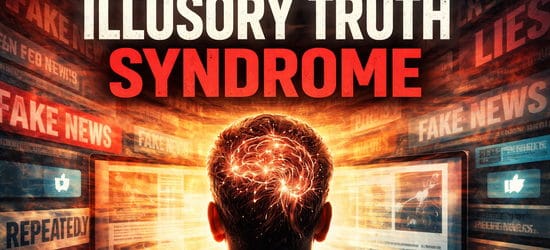
The illusory truth effect, also known as the illusion of truth, validity effect, truth effect, or reiteration effect, is a cognitive bias where individuals are more likely to believe information—whether true or false—after repeated exposure. This phenomenon was first identified in a 1977 study conducted at Villanova University and Temple University by psychologists Lynn Hasher, David Goldstein, and Thomas Toppino, published in the Journal of Verbal Learning and Verbal Behavior (DOI: 10.1016/S0022-5371(77)80012-1). Their research involved presenting college students with lists of 60 plausible statements, some true and some false, over three sessions spaced two weeks apart. Twenty statements were repeated across all lists, and participants rated their confidence in the truth or falsity of each statement on a scale. The study found that confidence in repeated statements increased from an average of 4.2 to 4.7 on a 7-point scale, suggesting that repetition enhances perceived truthfulness, even for false information.
The mechanism behind this effect is rooted in processing fluency, where repeated statements become easier to process cognitively. This fluency is often misattributed as a signal of truth, as familiarity in the natural world often correlates with accuracy. For example, participants in the 1977 study believed statements like “A sari is the name of the short plaid skirt worn by Scots” after repetition, despite knowing the correct answer, illustrating how fluency can override factual knowledge. This explanation is supported by detailed discussions on Illusory Truth Effect Wikipedia Page and Illusory Truth Effect Psychology Today , which highlight how processing fluency equates with perceived truth due to natural correlations.
Immediate Concerns and Real-World Implications
The illusory truth effect has significant implications across various domains, particularly in today’s information-rich environment. One major concern is the spread of misinformation, especially on social media platforms, where false information can be shared and repeated, gaining traction as truth. For instance, the 2008 birther conspiracy, which falsely claimed Barack Obama was not born in the U.S., persisted despite proof like his Hawaiian birth certificate, highlighting how repetition can fuel false narratives, as noted on Illusory Truth Effect Wikipedia Page. This is further detailed in Illusory Truth Effect Investopedia, which states that social media provides perfect conditions for exploiting this cognitive bias, making untruths go viral and become ingrained beliefs.
Another concern is its impact on consumer behavior. In advertising, repeated claims, even if unfounded, can influence purchasing decisions. For example, shoppers might believe a product prevents colds based on repeated ads, despite no evidence, as noted in discussions on Adcock Solutions Illusory Truth Effect
. This effect also extends to politics, where repeated political messages can sway voter perceptions, potentially manipulating public opinion for ideological gain, as discussed in FS Blog Illusory Truth Effect, which mentions propaganda models like the firehose model by Christopher Paul and Miriam Matthews at Rand Corporation, featuring high-volume, multi-channel, rapid, continuous repetition.
Experts are not immune, with research suggesting vulnerability due to “knowledge neglect,” where they fail to use stored knowledge and rely on fluency as a truth cue. This was detailed in Illusory Truth Effect Psychology Today, noting that analytical thinking offers no protection against this bias. Culturally, the effect contributes to memes and misconceptions, such as the belief we only use 10% of our brains, further embedding false beliefs in society, though specific sources for this example were not confirmed in Illusory Truth Effect The Decision Lab, which instead mentions examples like vitamin C preventing colds.
Strategies to Counter the Effect
To mitigate the illusory truth effect, several remedies have been proposed and studied. Critical thinking is fundamental, encouraging individuals to question repeated information and seek evidence before accepting it as true. Fact-checking is another vital strategy, with resources like Snopes Fact Checking Resource and PolitiFact Fact Checking Resource providing tools to verify claims. Media literacy education is also crucial, teaching people how to evaluate the credibility of information sources and recognize manipulative tactics, such as repetition for persuasion, as suggested by Understanding Combating Illusory Truth Effect The Mind Spa Innovative approaches include the “truth sandwich” method, advised by cognitive linguist George Lakoff in an X post (George Lakoff on Truth Sandwich X Post), which involves framing lies with truths—starting with truth, briefly mentioning the lie, and ending with truth again—to contextualize and diminish the impact of false information. Another strategy, “pre-bunking,” involves proactively exposing people to flawed argumentation and scientific consensus to inoculate them against disinformation before it gains traction, as noted in Illusory Truth Effect Psychology Today. These methods aim to build resilience against misinformation, particularly in an era of rapid information spread.
Potential Consequences of Inaction
If the illusory truth effect is not addressed, the consequences can be severe and far-reaching. False beliefs may become entrenched, making it difficult to correct misconceptions, as repeated exposure reinforces familiarity over fact. This can erode trust in legitimate sources and institutions, leading to a general skepticism of media and authority, as discussed in Illusory Truth Effect Investopedia. Social and political instability may follow, with polarization and conflict arising from belief in conflicting false narratives, exacerbating social divides and undermining democratic processes, as highlighted in FS Blog Illusory Truth Effect. Poor decision-making is another risk, particularly in areas like health and finance, where believing false claims can lead to harmful behaviors or neglect of proper advice. For example, believing vitamin C prevents colds despite evidence to the contrary, as mentioned in Illusory Truth Effect The Decision Lab, could result in inadequate health practices. Societies may also become more vulnerable to manipulation, with bad actors exploiting repetition to spread falsehoods for personal or ideological gain, as noted in FS Blog Illusory Truth Effect
Conclusion
The illusory truth effect is a pervasive cognitive bias with significant implications for individual decision-making and societal dynamics. By fostering critical thinking, leveraging fact-checking resources, and employing strategies like the truth sandwich and pre-bunking, individuals and institutions can mitigate its impact. However, failure to address it risks deepening false beliefs, eroding trust, and increasing vulnerability to manipulation, with potential for lasting social and political consequences. This analysis, grounded in recent research as of April 28, 2025, underscores the importance of awareness and action in navigating the challenges posed by this effect.
Key Citations
- Illusory Truth Effect Wikipedia Page
- Illusory Truth Effect Psychology Today
- Illusory Truth Effect The Decision Lab
- Illusory Truth Effect Investopedia
- Understanding Combating Illusory Truth Effect The Mind Spa
- Snopes Fact Checking Resource
- PolitiFact Fact Checking Resource
- George Lakoff on Truth Sandwich X Post
- Adcock Solutions Illusory Truth Effect
- FS Blog Illusory Truth Effect
- Tucker&Otis@Tucker_and_Otis

- Commentary account Sons of the Revolution descendant

- | Left-leaning voice for democracy, verifiable truth & justice. basset hounds



Member discussion